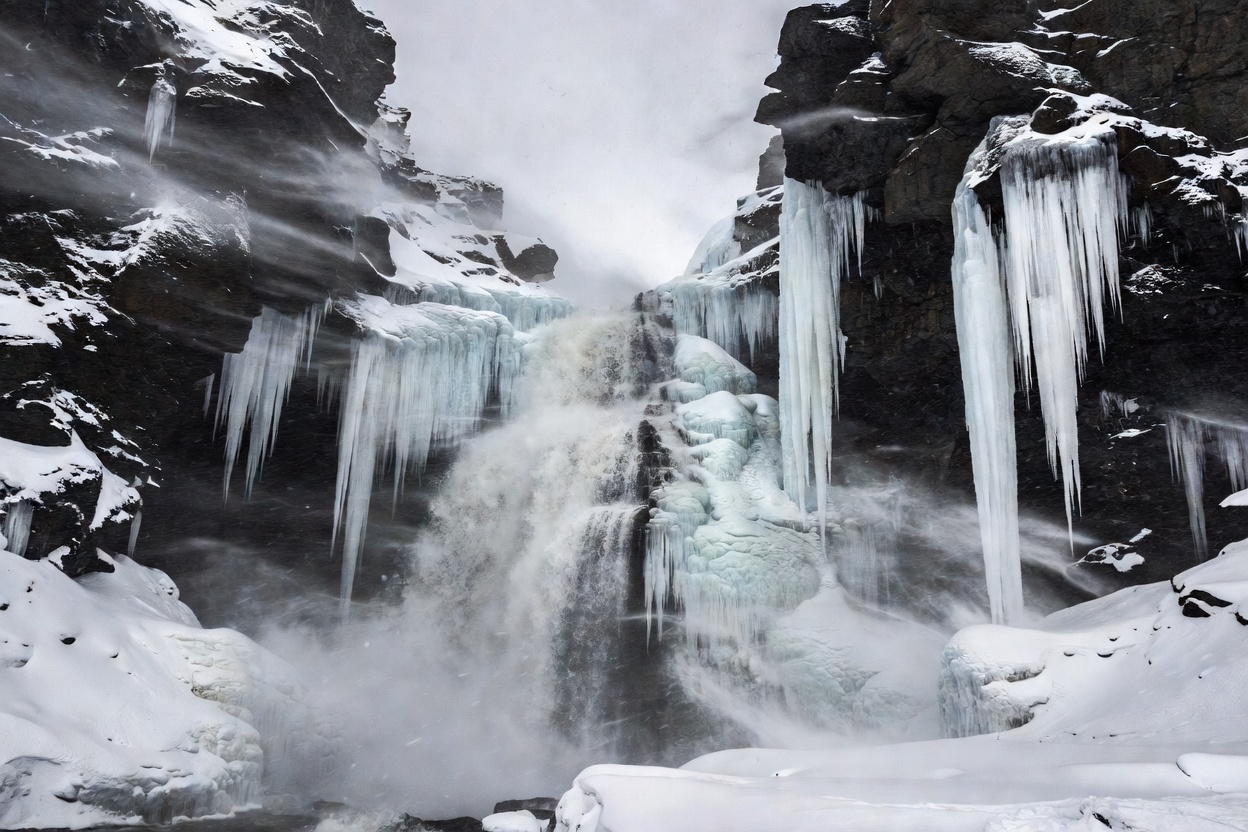
Seasonal Transformations: Ice to Torrent
Iceland's subpolar oceanic climate subjects waterfalls to violent environmental transitions. A cascade that presents as a gentle curtain in July can become a lethal wall of falling ice chunks in February or an impassable mud deluge in May.
Understanding these quarterly phases is essential for personal safety, equipment protection, and road passability.
1. Winter: November Through March
Winter does not halt waterfall flow entirely. Core torrents remain active beneath thick ice shells. Spray droplets freeze instantaneously upon contact with canyon walls, steps, and handrails, building smooth ice slopes.
Falling ice hazards are severe. Massive icicles weighing dozens of kilograms detach from basalt overhangs as temperatures fluctuate across the 0°C threshold. Standing directly beneath waterfalls (such as the cavern behind Seljalandsfoss) is extremely hazardous and routinely prohibited by authorities in winter.
Required equipment: Steel microspikes or crampons with minimum 10mm spikes, hardshell pants, insulated base layers, and ski goggles for high-wind spray protection.
2. Spring Melt: April Through Late May
Rising temperatures trigger the annual snowpack thaw. River volumes spike dramatically, frequently doubling or tripling normal cubic-meter-per-second discharge rates.
Water clarity degrades as brown glacial sediment and mud flood the channels. The surrounding terrain undergoes "frost heaving" (Icelandic: vorleysa), converting tundra paths into deep knee-deep mud baths. Many unpaved trails are formally closed by environmental rangers during this window to prevent irreparable damage to delicate subarctic soil.
3. Summer: June Through August
Summer offers stable temperatures (ranging typically from 8°C to 15°C) and extended daylight. Trails are dry and accessible on foot without specialized ice equipment.
Discharge from glacial rivers (such as the Hvítá feeding Gullfoss) reaches its peak due to maximum summer ice melt on Vatnajökull and Langjökull. Mist volumes reach their widest radius; waterproof rain jackets and pants remain necessary even under clear sunny skies.
4. Autumn: September Through October
Autumn brings violent North Atlantic low-pressure systems. Rapid gale-force winds exceeding 30 m/s (67 mph) can sweep through southern valleys.
Light levels deteriorate quickly. Wet snow and sleet begin glazing high-elevation trails. This is a critical transition period requiring constant monitoring of road surface advisories.
| Season Phase | Mean Temp | Primary Field Hazard | Mandatory Protection |
|---|---|---|---|
| Winter (Nov–Mar) | -5°C to +2°C | Black ice steps, falling ice daggers | Microspikes, hard shell, eye goggles |
| Spring Melt (Apr–May) | +1°C to +7°C | Mud slurry, seasonal trail closures | Gore-Tex boots, gaiters, route verification |
| Summer (Jun–Aug) | +8°C to +15°C | Intense mist saturation, high crowds | Lightweight waterproof shell, lens cloth |
| Autumn (Sep–Oct) | +2°C to +8°C | High wind shears, sudden freeze-thaw | Windproof layers, headlamps, backup power |
GOOD FOR
- Selecting the right seasonal clothing layers before arriving in Iceland.
- Anticipating seasonal path closures during spring thaw intervals.
- Choosing appropriate traction devices for winter waterfall trails.
WHAT TO KNOW
- Never trust historical temperature averages when packing; daily weather swings in Iceland are extreme.
- Wind warnings are color-coded (Yellow, Orange, Red). Orange alerts indicate dangerous driving conditions for high-sided vehicles.
- Always confirm that emergency contact services are reachable from your accommodation base.
Questions on seasonal gear suitability? Our team can clarify trail equipment requirements for specific months.
INQUIRE ABOUT CONDITIONS