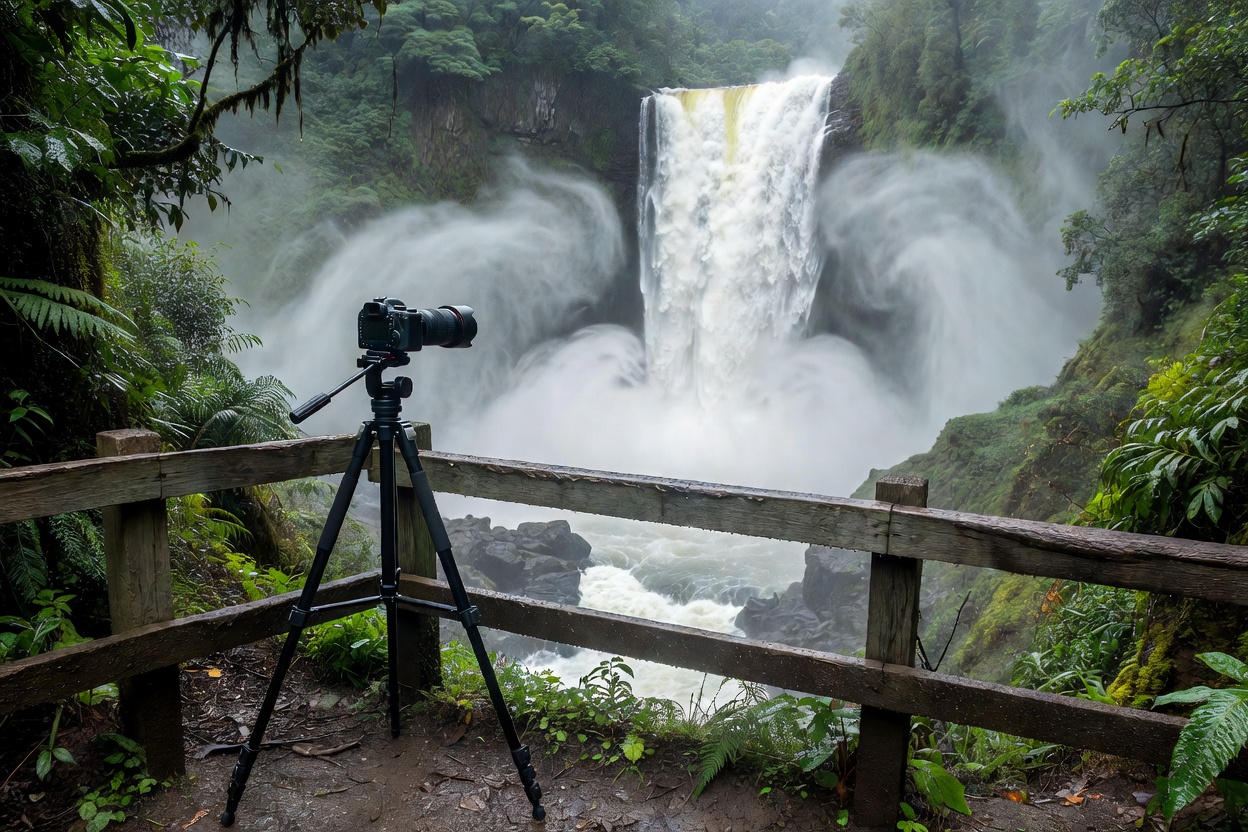
Optical Protection in Airborne Water Columns
Photographing Icelandic waterfalls presents acute technical challenges. Falling water masses create localized wind vortexes that throw mineral-rich spray hundreds of meters in all directions.
Standard weather sealing on professional camera bodies is insufficient against prolonged pressurized mist. Moisture penetrates zoom barrels, electronic lens mounts, and battery door seals, causing electronic failure.
1. Lens Maintenance Protocol
Front elements saturate within 3 seconds when pointed directly at falls like Skógafoss or Dettifoss. Wiping the glass with a standard dry microfiber cloth creates smears of volcanic dust that can permanently scratch optical coatings.
Protocol: Keep the lens hood attached at all times to block peripheral spray. Shield the front glass with a dedicated lens cap until the composition and focus are locked. Remove the cap, trigger a burst of three exposures, and immediately re-cover the optic.
Carry at least six separate dry lint-free microfiber towels stored in individual sealed ziplock bags. Once a towel becomes damp, store it separately; reusing a damp cloth simply redistributes mineral film.
2. Tripod Stabilization in Wind Shear
Tripods set up on boardwalks or gravel lookouts are subject to micro-vibrations from pedestrian foot traffic and sustained canyon winds.
Do not extend the thin center column of your tripod. Keep leg sections as wide and thick as possible. Hang your daypack from the center hook to lower the center of gravity, but ensure the pack rests lightly on the ground so it does not oscillate in high winds.
On metal mesh platforms, rubber tripod feet provide better purchase than spikes, which can slide on galvanized steel bars.
3. The Fragility of Icelandic Moss Biomes
Iceland’s green woolly fringe moss (Racomitrium lanuginosum) grows on lava fields at an exceptionally slow rate: roughly 1 millimeter per year. A single footprint can crush decades of organic growth.
Because the underlying volcanic soil is thin and highly erodible, destroyed moss leaves bare ash exposed to Arctic winds, triggering severe soil erosion that can wash away entire trail banks.
Stepping over rope barriers to achieve an unobstructed photographic angle is strictly prohibited by Icelandic conservation law. Never place tripod legs or camera bags on moss cushions.
| Field Challenge | Impact Mechanism | Standard Mitigation |
|---|---|---|
| Airborne Silt Mist | Scratches coatings; shorts internal circuits | Silicone rain covers; dry sealed microfibers |
| Boardwalk Foot Shake | Motion blur on long exposure (1/2s to 2s) | Shoot between foot traffic; fast electronic shutter |
| Off-Trail Moss Trampling | Irreversible vegetation loss and erosion | Strict containment within timber/rope rails |
| Drone Turbulence | Bird nesting disturbance; crash in gorges | Comply with strict national park drone bans |
GOOD FOR
- Preserving camera optics and electronics in saturated waterfall micro-climates.
- Executing sharp long-exposure water captures without camera shake.
- Ensuring zero environmental degradation of subarctic flora and moss banks.
WHAT TO KNOW
- Drones are banned at almost all major Icelandic waterfalls (including Gullfoss, Skógafoss, and Seljalandsfoss) to protect wildlife and visitor peace.
- Never lean over cliff railings to position a lens; gusts can pull equipment from your hands into inaccessible gorges.
- Always yield walking paths to other visitors when setting up bulky photographic tripods.
Photographic permit or conservation question? Reach out to our field communications desk for details on park permissions.
CONTACT ETHICS DESK